
Mass Graves: Nine years on, no justice for Wang Kelian’s 139 human trafficking victims
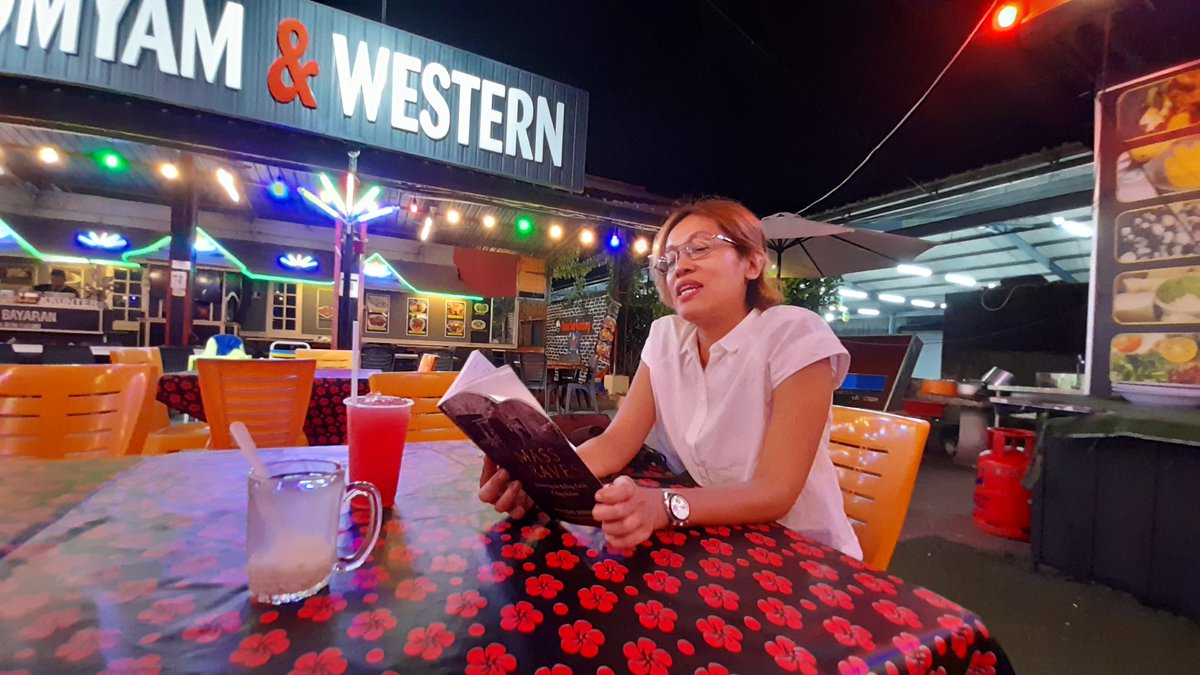
We missed the book talk on Mass Graves: Uncovering the Killing Fields of Wang Kelian during the Kuala Lumpur International Book Fair (KLIBF) in June 2024. So we bought the book online and spent two months reading Arulldas Sinnappan’s investigation into one of the most heinous human trafficking crimes Southeast Asia has ever seen. The story was first broken by him in 2015 via a local newspaper, the Malay Mail.
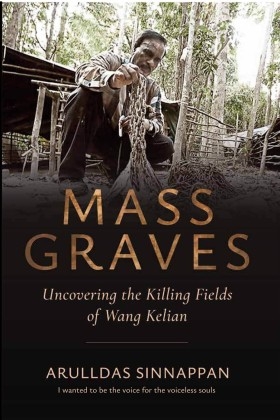
If you don’t mind the typos (not a lot), then you’ll be intrigued by the courageous exposé by the veteran investigative journalist. There are three parts to this book:
- The crimes that led Sinnappan to investigate the 139 mass graves on the border of Malaysia and Thailand: an 11-month murder spree of Myanmar nationals by Rohinya migrants in Penang, Malaysia, in 2014. Judging from the severity of the murders – decapitations, dismemberment and body parts left near police stations – it was obvious these were revenge attacks. But why?
- The discovery of possible involvements from local authorities from both sides of the border. Also, the realisation that the ‘human trafficking index’ or whatever ‘supply chain sustainability’ standard that the Western countries wave about to get poor countries in line can be no more than a political bargaining chip.
- Why the Rohingya refugees left Bangladesh’s Cox’s Bazar for the treacherous seas to make it to Thailand, Malaysia and Indonesia. The answer: destitution, prostitution and having a stab at a better life. Refugees paid fees of up to US$4000 (RM19,060) per head and many met horrific, desperate deaths at sea.
The crimes that led Sinnappan to investigate the 139 mass graves on the border of Malaysia and Thailand: an 11-month murder spree of Myanmar nationals by Rohinya migrants in Penang.
On 13 May 2015, Sinnappan, photojournalist Sayuti Zainuddin and two Thai contacts found 139 graves at Wang Kelian, a border town in Perlis, north of Peninsula Malaysia. It wasn’t a first-time discovery but it corroborated the reports and rumours Sinnappan had heard about the human trafficking activities along the border of Thailand and Malaysia.
As a result of the Wang Kelian discovery, in Malaysia, four foreign nationals – one Bangladeshi, two Rohingya and one Thai – were prosecuted. Twelve Malaysian policemen were also arrested. However, by 2022, the Royal Commission of Inquiry (RCI) found no Malaysian enforcement officials, public servants or locals involved in human trafficking. They walked free. In contrast, 62 people were convicted for human trafficking and murder in Thailand in 2017.
In 2015, months after the discovery of the mass graves, the US State Department’s Trafficking In Person (TIP) report awarded Malaysia an upgrade from Tier 3 to Tier 2 in 2015, apparently to coax Malaysia into buying into the Trans-Pacific Partnership (TPP) agreement.
Mass Graves is a good read but it’s also horrifying. There are 133 pages in this book but it’s so rich with anecdotes and facts that you wonder why human trafficking is still tolerated in Southeast Asia. There are historical and anthropological factors not mentioned here which merit a separate book that can explain ‘social collusion’. However, this is not a safe topic for Malaysians. Sinnappan and his photographer actually feared for their lives whilst doing the investigation.
This is not a safe topic for Malaysians. Sinnappan and his photographer actually feared for their lives whilst doing the investigation.
If the lack of justice doesn’t move you, then perhaps this will: some of the refugee women were sold as wives. A woman related to Sinnappan about the repeated rapes endured by her and her two daughters during their journeys from Myanmar to Malaysia. Her husband, who travelled with them on one of the journeys – and who would have witnessed the rapes – died at a hospital in Perlis not long after arriving in Malaysia. One of her daughters successfully obtained a United Nations High Commission for Refugees (UNHCR) card. They now could reside in Malaysia. And that was the silver lining in the cloud.
More on Mass Graves
- Mass Graves: Uncovering the Killing Fields of Wang Kelian (Gerakbudaya)
- Wang Kelian RCI: Pressmen recall ease of crossing Malaysia-Thai border (Malay Mail, 8 May 2019)
- Strong evidence of abuse and fear uncovered at Perlis trafficking camp site (Malay Mail, 26 May 2015)

Wideacre to be adapted for television, at last
It took this long for Wideacre by Philippa Gregory to be optioned, but at last the novel is to be adapted for the small screen. Happy Prince, part of ITV Studios, have optioned the right to the 1987 book.
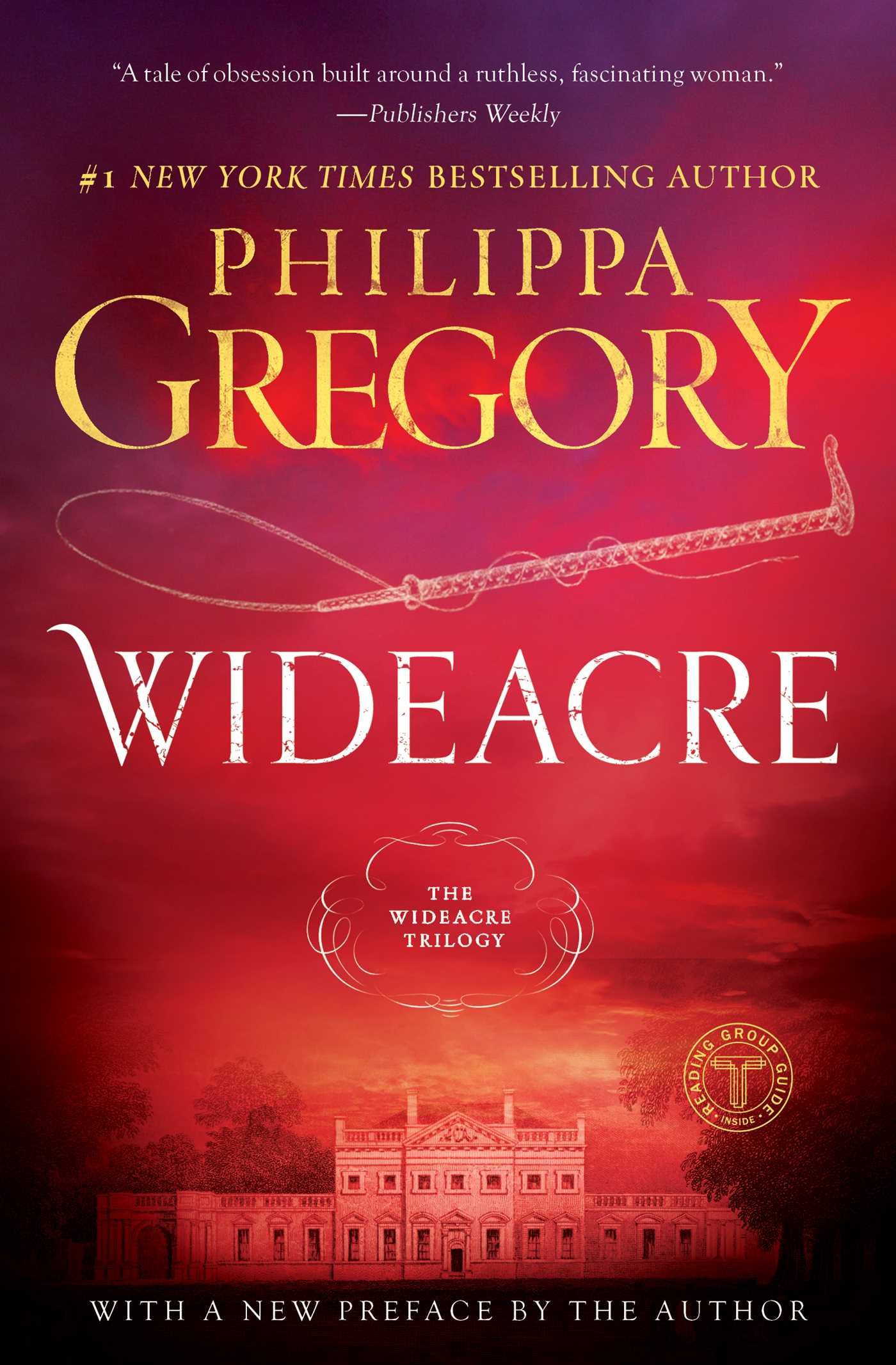
This is big news for Gregory’s fans because Wideacre doesn’t play safe with its plot. Set in the 18th Century, the book – part of a trilogy – centers on the incestuous relationship between the protagonist, Beatrice Lacey, and her brother, Harry Lacey. It unflinchingly examines the tactical reasons behind the incest: the oppressive inheritance law that favours men and the women’s fear of dispossession. Bold, feminist and unsettling, Wideacre makes Virginia Andrews’s Flowers in the Attic sounds like something out of Sweet Valley High.
Who’s going to play the audacious, manipulative and murderous Beatrice Lacey? That’d be interesting to watch. If you think Game Of Thrones prepares you for a story of overzealous family affections, then brace yourself for this one.
More on Wideacre
Pachinko: The TV series of the year
It’s not the end of the year, and Apple TV+ has already got book fans enthralled by a superb screen adaptation of Pachinko by Min Jin Lee.
Pachinko is easily the TV series of the year. It follows the life of three generations of a Korean-Japanese family between the 1910s and 1980s. They survive discrimination by passing as Japanese or adopting a Western culture for social mobility. The resilience of Sunja, the female protagonist from Busan who raises her two sons and grandson through so much hardship, will win you over. Noa, her eldest son, decides to give up his Korean identity to fully become Japanese. Her grandson, Solomon Baek, the Yale-educated Korean Japanese, code-switches in and out of Japanese, Korean and English to reach the pinnacle of his banking career – but not without sacrifices. If you’re a fan of K-drama actor Lee Min-ho, we’ll have you know that the handsome actor plays a total bastard in the series.
Season 2 ended in October 2024, and fans are clamouring for Season 3. If you don’t mind watching it in Korean, Japanese and English, then this is the drama for you.
More on Pachinko
Nasty mom steals the show again in Disclaimer
Renée Knight’s Disclaimer, directed by Alfonso Cuarón, divided fans of feminist thrillers, and for that, we love this Apple TV+ adaptation. The feminist reviewers hate it. Variety calls it “a failed attempt at a feminist thriller”. The Guardian finds the script “abominable”. TV Guide says “Disclaimer’s final hour gives itself a pat on the back while presenting its middle finger to the viewer”.
It could be because the main character portrayed by Cate Blanchett – the manipulative Catherine Ravenscroft – is the ‘narcissistic mother’ stereotype that female writers absolutely despise. It could also be the gratuitous sex scenes (central to the story, of course) that reveals how Catherine manipulates the hapless 19-year-old man who later dies tragically. Do you need to see Catherine’s breasts to understand that she cheats on her husband? No. Esquire finds the intense flirtation between Catherine and the young man “excruciating and completely incredible, like Lloyd Christmas’s sex-dream in Dumb and Dumber”.
But don’t let that put you off. It really is a good thriller. Book fans should watch Disclaimer because the storytelling is amazing. Also, it has two well-known comedy actors – Kevin Kline and Sacha Baron Cohen – cast in serious roles, and they’re absolutely brilliant. Like a Redditor said: “It is insanely addictive trash and I adore it.”
More on Disclaimer




 Story Of Books
One response to “Autumn thrillers to watch out for”
[…] Pachinko, the 2017 epic novel about three generations of a Korean Japanese family, comes in three sections, each representing a generation of the Baek family. The book is better than the Apple+ TV series, which is a compliment because the trilingual screen adaption is also brilliant (read our review). […]