
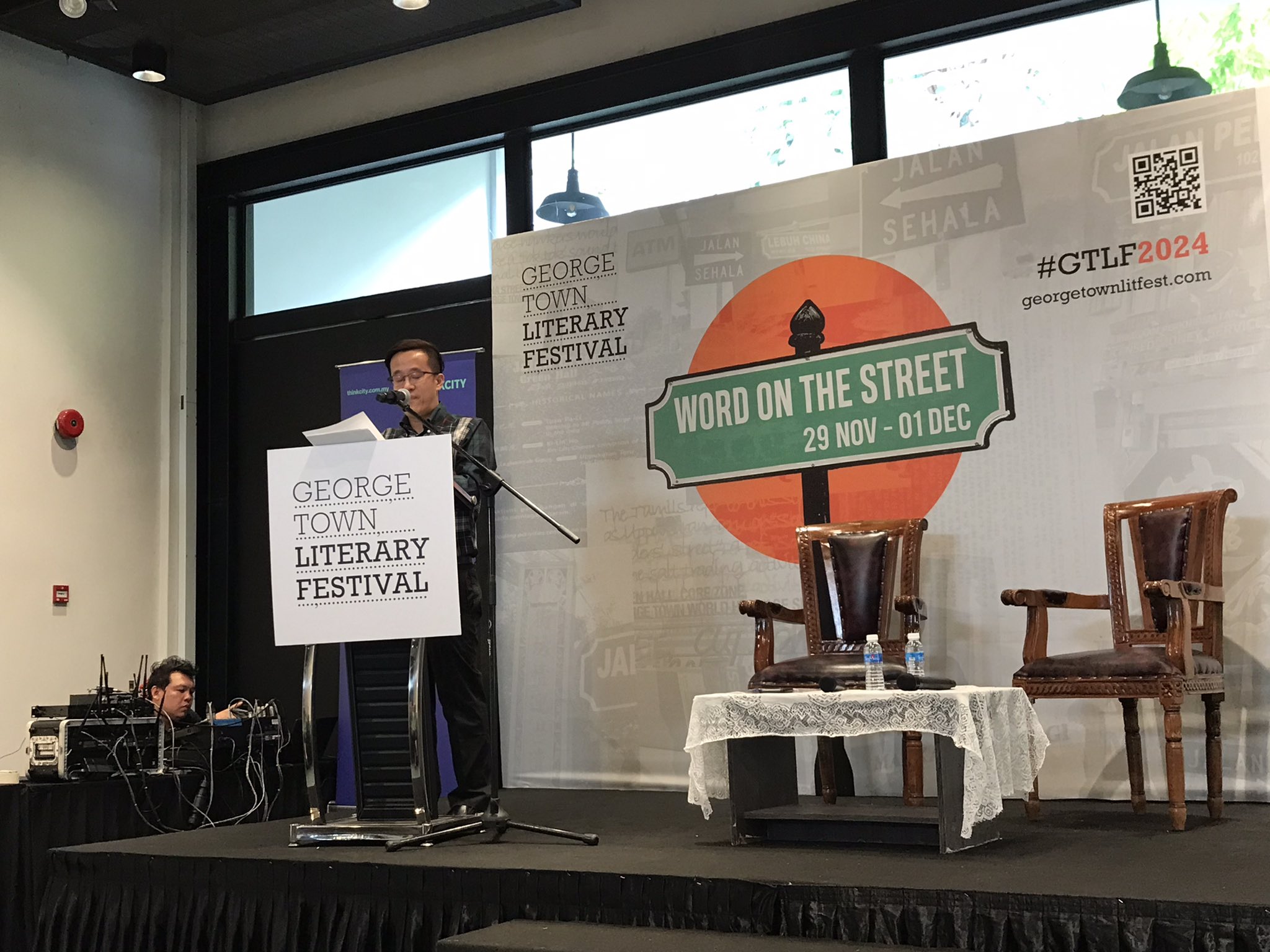
- Panel: Mahua Literature: Global Vision from the Margins.
- Moderator: Dr Show Ying Xin.
- Speaker: Dr Chan Cheow Thia, assistant professor, Department of Chinese Studies, the National University of Singapore (NUS).
There was a lot to unpack at the Mahua Literature session by Singaporean scholar Dr Chan Theow Thia at the George Town Literary Festival 2024. As inductees to this topic who don’t speak Chinese, we did plenty of furious notetaking as Dr Chan ran through his slides. It was a proper lecture.
Mahua: a cross-border phenomenon
Mahua – Chinese-Malaysian literature but also incorporating works by Singaporean authors – is small, marginalised but dynamic in its evolution and contribution to the Malaysian cultural identity. Writers in this genre are divided by, but not limited to, these categories:
- Migrant writers from mainland China who resided and published their works in Malaya.
- Southeast Asian writers established in Taiwan who published their works there.
- Writers from mainland China who write about their Southeast Asian roots.

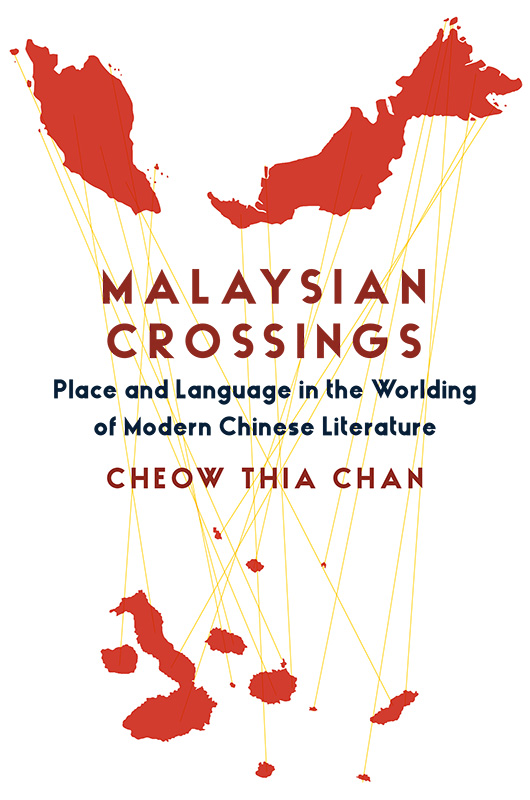
Borrowing from author Ng Kim Chew’s theory of the Literary Galapagos archipelago, Dr Chan explained that Mahua literature thrived despite its insularity, a paradox akin to the ecosystem that Charles Darwin observed in The Origin of Species.
For his book, Malaysian Crossings: Places and Language in the Worlding of Modern Chinese Literature, Dr Chan examined Mahua from the margin and not from the centre of cultural prestige. He invited us to view Mahua as more than “sastera sukuan”, that is, sectional or ethnic literature.

The Q&A session threw some interesting insights. A member of the audience asked about Mahua’s influence over mainstream pop culture. The 2023 film Abang Adik penned by Jin Ong got a mention.
Our view is that Abang Adik is a success with Malaysians because the film depicts life as Malaysians know it. They recognise themselves in the situations presented by Abang Adik. It’s not a fantasy about rich Asians driving Porsches and romancing all over the globe, with no worries over bills – although we’d argue for the existence of that trope, too.

The need for translation
But there lies the question: is there more to these Mahua stories that non-Chinese speakers can read about? What about sub-genres within Mahua such as horror and fantasy? Are there translations? Is the translation sufficient for the wider public?
Translation was one of the topics touched by Dr Chan. No doubt policy from the above would help public appreciation of Mahua tremendously.
Is there more to these Mahua stories that non-Chinese speakers can read about? What about sub-genres within Mahua such as horror and fantasy? Are there translations? Is the translation sufficient for the wider public?
Another member of the audience – British we assume – asked Dr Chan if Galapagos really is insular. Different species co-exist on the island and interact with one another despite the insularity. As such, is Mahua insular in its progression?
Which reminds us: in linguistics, there’s a school of thought (Labov) that asks us to look at the environment a language is in, in order to understand the latter’s evolution. It’s just another theory but quite handy to use for framing. There’s a separate study by Tan Kok Chin et al (August 2024) that encourages us to examine the development of Mahua in relation to its interaction with modern Malay Literature. The proposal is congruent with the Galapagos theory.
The Mahua Literature session was truly insightful. We think it deserves to be run as a stream, with sub-topics mentioned by Dr Chan divided into separate talks. There’s definitely interest from the wider public. If the translation of the qualifying body of works is made a policy by the Malaysian government, then there’s a good reason to translate Mahua into other Malaysian languages including English. The same concept could work for literary works in other Malaysian languages. Translation helps a genre to scale beyond its primary audience. There’s a business case in this, as well as sociocultural.
About the author
- Dr Chan Cheow Thia
- Malaysian Crossings: Places and Language in the Worlding of Modern Chinese Literature (ISEAS – Yusof Ishak Institute / Columbia University Press)
More on the George Town Literary Festival 2024
- GTLF 2024: How to use word on the street to shape your story (4 December 2024)
- GTLF 2024: Immersing the reader with places and memories (6 December 2024)






 Story Of Books
4 responses to “GTLF 2024: A case for scaling up Mahua Literature”
[…] GTLF 2024: A case for scaling up Mahua Literature (Story Of Books, 5 December 2024) […]
[…] GTLF 2024: A case for scaling up Mahua Literature (Story Of Books, 5 December 2024) […]
[…] GTLF 2024: A case for scaling up Mahua Literature (5 December 2024) […]
[…] GTLF 2024: A case for scaling up Mahua Literature (5 December 2024) […]