
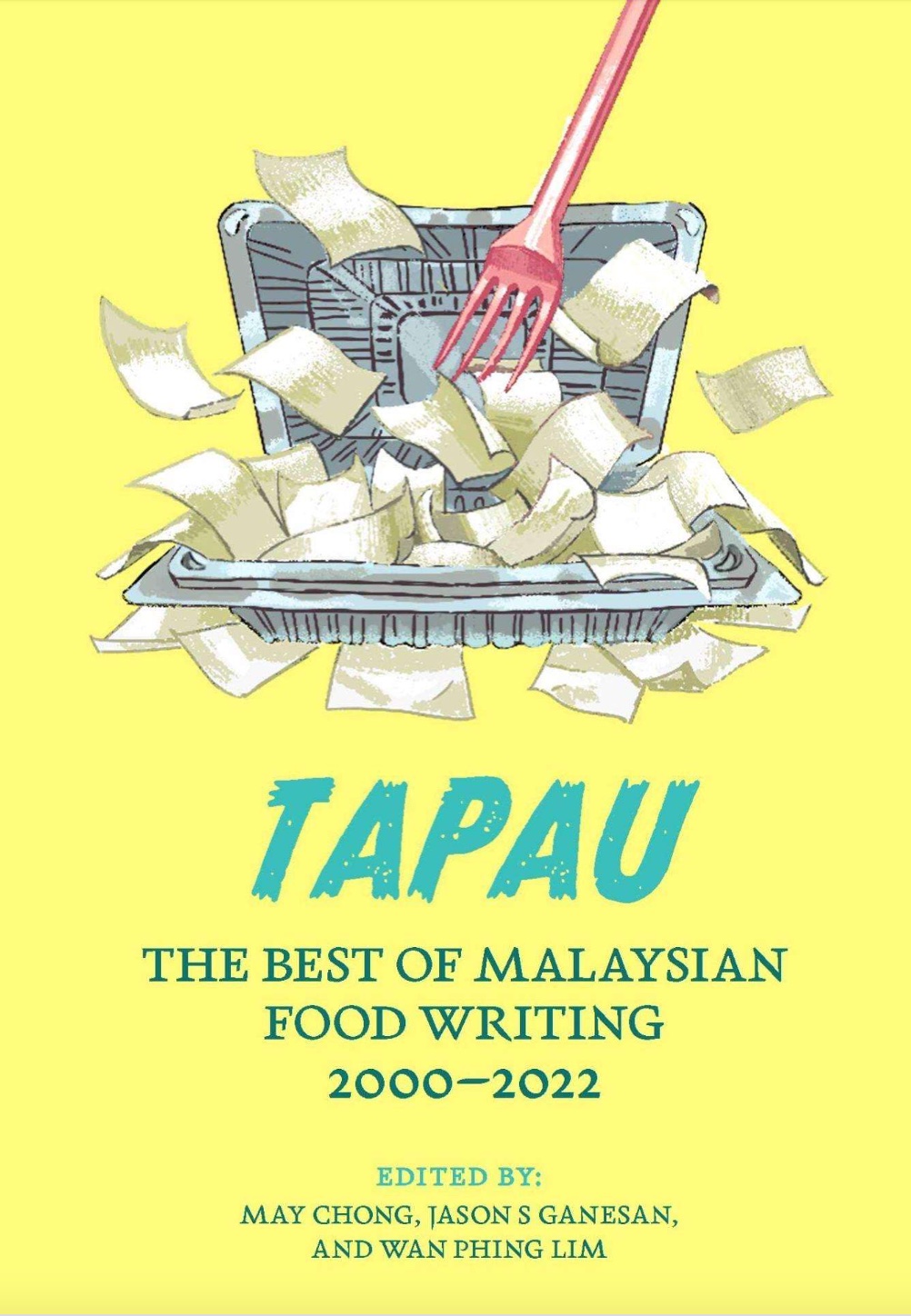
Tapau is an anthology that combines short stories, essays, poems and comic strips. It reads like a magazine. Tell us the reason behind Tapau being published as a book.
May Chong: Honestly, there was no particular reason. Anthologies are a familiar format for us both as Malaysian Writers Society members (this one’s our fourth) and readers. If the hungry reader gets to wander from part-to-part sampling the good bits — which is what I used to do with my magazines — then we’re doing well.
The contents aren’t grouped by category or segment, such as ‘fiction’ and ‘non-fiction’. Each piece ends with an explanatory footnote by its author. It doesn’t follow the classic linear chaptering we normally find in books. It has the potential of being a very interactive digital book, if formatted for that end. Could you describe the user experience that Tapau offers to the reader?
Jason S Ganesan: The editors discussed several ways to sequence Tapau — by cuisine, by category — but we eventually agreed that the best way to do it would be to group the entries by theme. This way, the reader gets the feel of a buffet rather than that of a strict tasting menu.
The Nyonya Food essay by Siti Zaharah Syahiera Fauzi and Siti Nuraisha Ahmad frames the Peranakan Chinese food production as an agency for female empowerment. Which Came First, Chneh Hu or Pasembur by Ong Jin Teong and Peter Yeoh explores the intersectionality of the mamak snack pasembur, looking at its possible origins in China and India, and its hybridisation in Malaysia. Very insightful essays. Why did the editors of Tapau include social science essays in between the food writings?
Jason S Ganesan: The short answer is that both Nyonya Food, Culinary Capital, and Women’s Empowerment and Which Came First, the Chneh Hu or Pasembur? are fascinating! The long answer is that since the thread that runs through the non-fiction entries in Tapau is meaning-making, the two entries give some insight into how that meaning is crafted and shifts over time — as opposed to being fixed and handed down wholesale over generations — in a historical context where the boundaries of cultural identities were arguably more in flux.
“Since the thread that runs through the non-fiction entries in Tapau is meaning-making, the two entries give some insight into how that meaning is crafted and shifts over time — as opposed to being fixed and handed down wholesale over generations.”
Nyonya Food, Culinary Capital, and Women’s Empowerment provides counterbalance — and perhaps a measure of authorial agency — to the idea that food fictions can devolve into “Oriental exotica” for the colonial gaze, while Which Came First, the Chneh Hu or Pasembur?, in my reading, is quintessentially Malaysian, with a dish becoming what it is from borrowing, adapting, making do, and innovating, its origins appearing ever more distant with each phase of evolution.

Food is also examined within the concepts of the sacred and the profane. We love the short stories Pau Babi (Pork Bun) by Tilon Sagulu and French Fries for Aunty Kamalam by Sharmilla Ganesan. It’s amazing to think that despite prohibitions based on belief systems, Malaysian foods have this superpower ability to absorb influences from many cultures and cross over to everyone’s dinner table, regardless. Like the rojak mentioned by Malachi Edwin Vethamani in his poem, My Palagaram and Your Kueh. Why do you think that is? What is it in the Malaysian character that enables this?
Wan Phing Lim: Well, Malaysian culture is multi-ethnic in the first place, so it’s no surprise that our foods are multi-ethnic too. It’s great that we can cross-over so easily, adapt one another’s food, give it our own spin and make it our own. Perhaps it’s in our relatively young nationhood (we are a postcolonial nation that is only 67 years old), therefore we don’t have centuries of culture to fall back on. Our identity is still in flux and a work in progress. The other thing about Malaysians is that we are a very creative and enterprising bunch. I once heard that kopitiam (coffee shop) drinks were invented by a trial of mix and match, and whatever worked and proved to be popular stayed to become staple drinks on the menu.
“We are a very creative and enterprising bunch. I once heard that kopitiam (coffee shop) drinks were invented by a trial of mix and match, and whatever worked and proved to be popular stayed to become staple drinks on the menu.”
May Chong: My hypothesis: we’re all driven by food, in greater or lesser ways. Like with many of our regional neighbours, a common greeting is “Have you eaten?”. It’s important that those around us are fed, and fed well! With that said, the crossing over and eagerness to make things our “own” sometimes ends up with the roots of said cuisine papered over. Case in point, related to Vethamani’s poem: I knew what kuih ros was long before I ever heard the words achu murukku.
People Will Talk by Sumitra Selvaraj is a short thriller that reminds us of The Yellow Wallpaper by Charlotte Perkins Gillman. Food production is perceived as feminine, to an extent, but feminist, too. What are the editors’ thoughts on this?
Wan Phing Lim: Wow, what a flattering comparison! As the fiction editor who selected this piece, I read it as a purely mental health story. The relationship between the mother and daughter was especially fascinating, as there is a sense that the mother doesn’t quite believe the daughter and is trying to turn the conversation away from a difficult one about her feelings to focus on something more practical, like food production.
What book did you last read?
Jason S Ganesan: I am still reeling from Shih-Li Kow’s short story collection Bone Weight and Other Stories that I picked up at the George Town Literary Festival. Other than that, I have been plugging away at Zoe Baker’s Means and Ends: The Revolutionary Practice of Anarchism in Europe and the United States, KS Maniam’s The Cry — largely for personal reasons, since Maniam taught a course for a semester at my university — and a bunch of old pamphlets and essays which I am in the process of translating into Malay.
Wan Phing Lim: Northern Lights by Tim O’Brien. It wasn’t very good, and very different from all his other books, like The Things They Carried. Before that I read Malayland by Dina Zaman, which I picked up at the George Town Literary Festival 2024. It was an insightful look into the psyche of Malaysian Malays.
May Chong: Noah Strycker’s The Thing with Feathers, which is a lovely journey through the world of birds and what humans can learn from them. Post-pandemic my attention span has me preferring short stories; one that left a mark recently was Cressida Blake Roe’s The Godhood of Ima Day, a second person speculative piece on the nature of divinity. I’m also (very…very…slowly) getting through poet Yosano Akiko’s first collection, Midaregami (Tangled Hair).

Which format do you prefer: print, PDF or ebook?
Jason S Ganesan: I only purchased a secondhand Kindle from Carousell earlier this year, so I’m still pretty new to ebooks. Can’t really explain why, but so far I’ve found myself associating nonfiction with ebooks and fiction with print. Fiction PDFs are a non-starter for me—I had Blood Meridian; or, The Evening Redness in the West sitting half-read on my phone for the longest time. Given the recent Vanity Fair piece on Cormac McCarthy, however, I suppose it was for the best.
Wan Phing Lim: I prefer print, I’m old school! Love the tactile feeling of flipping a page and the texture of ink on paper.
May Chong: I’m also a print person! Credit where it’s due, though; what broke my last reading drought was an ebook of Seanan Mcguire’s Middlegame.
About Tapau: The Best of Malaysian Food Writing 2000-2022
- Publisher: Malaysian Writers Society; Zine: Nutmag (Penang chapter)
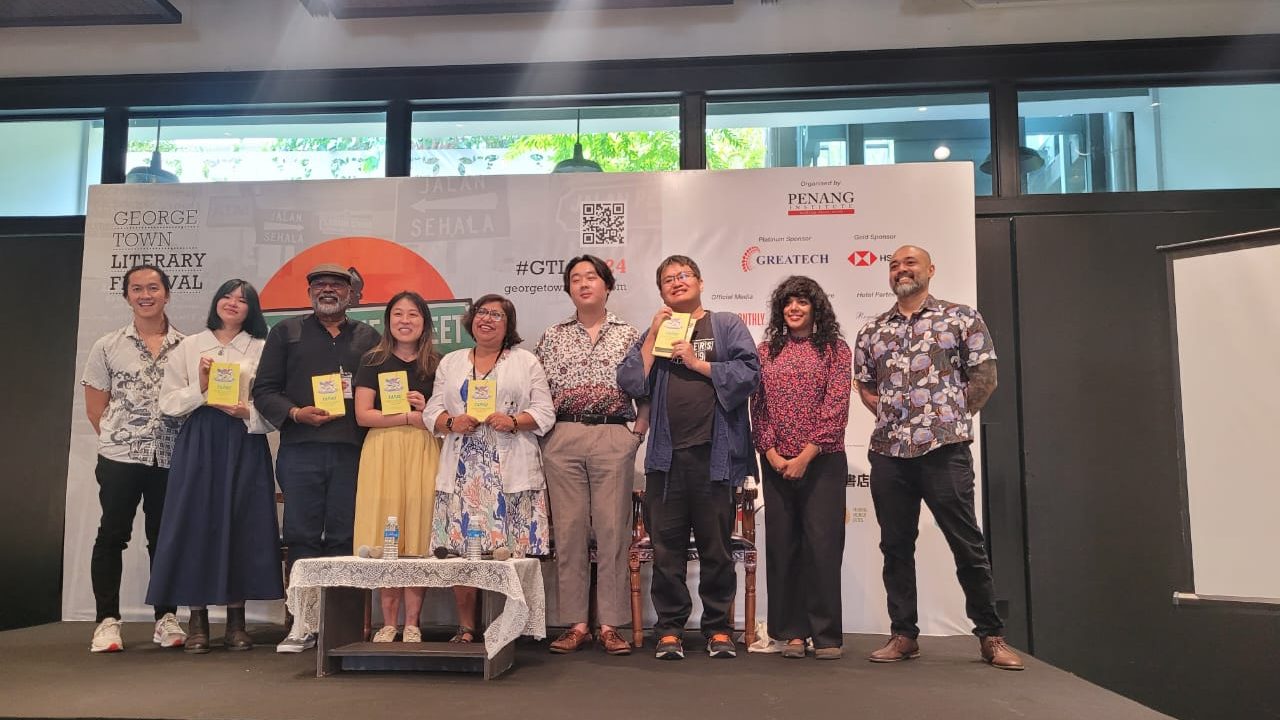
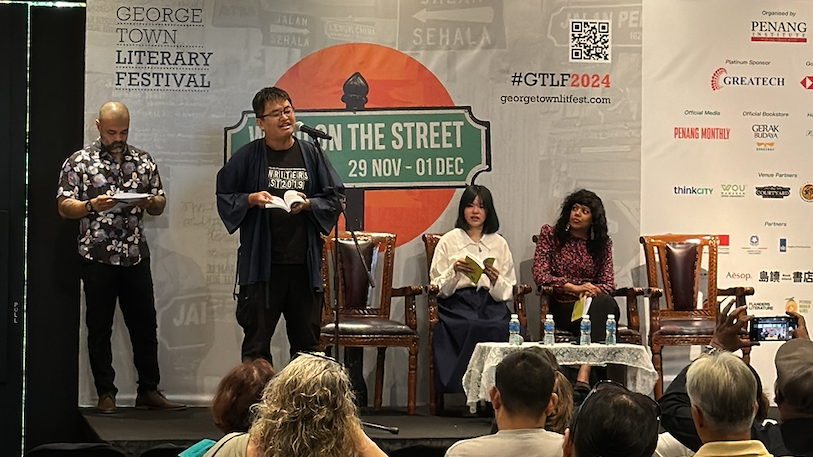
- Launch event: George Town Literary Festival 2024
More on George Town Literary Festival 2024
- GTLF 2024: Immersing the reader with places and memories (Story Of Books, 6 December 2024)
- GTLF 2024: A case for scaling up Mahua Literature (Story Of Books, 5 December 2024)
- GTLF 2024: How to use word on the street to shape your story (Story Of Books, 4 December 2024)
- Five Minutes With: Jack Malik, Poet (Story Of Books, 16 October 2024)




 Story Of Books