
The popularity of Guillermo Del Toro’s adaptation of Frankenstein reveals how obsessed we are with mortality. What horrifies us – death – preoccupies our minds. Mary Shelley understood this well when she wrote the novel. She gave us the template for the modern horror genre. And who else but Del Toro to pull off an adaptation of this scale? But like Professor Julie Carlson of University of California Santa Barbara said to Variety: “For Mary Shelley, it’s such a patriarchal world in the book. All the women – the mother, Elizabeth and Justine – are basically just sacrificed to patriarchy” (Variety, 8 November 2025).
Del Toro gives the female protagonist Elizabeth a voice – a departure from Shelley’s novel. But his Frankenstein still plays on the stereotype of the male as the saviour and destroyer, and women as men’s sacrificial victims. It’s a tried-and-tested formula that works in books as well as in films. So why challenge the inherent sexism in horror?
Femgore and pink horror
This was pretty much what the MCM Comic Con London’s panel, The Rise of Femgore, talked about at Writers Block on Saturday, 25 October 2025. Authors Eliza Clark, Gemma Amor, Kirsty Logan and Leigh Redford deliberated if femgore is the answer or epiphany to the male-oriented torture porn so prolific in horror spaces.
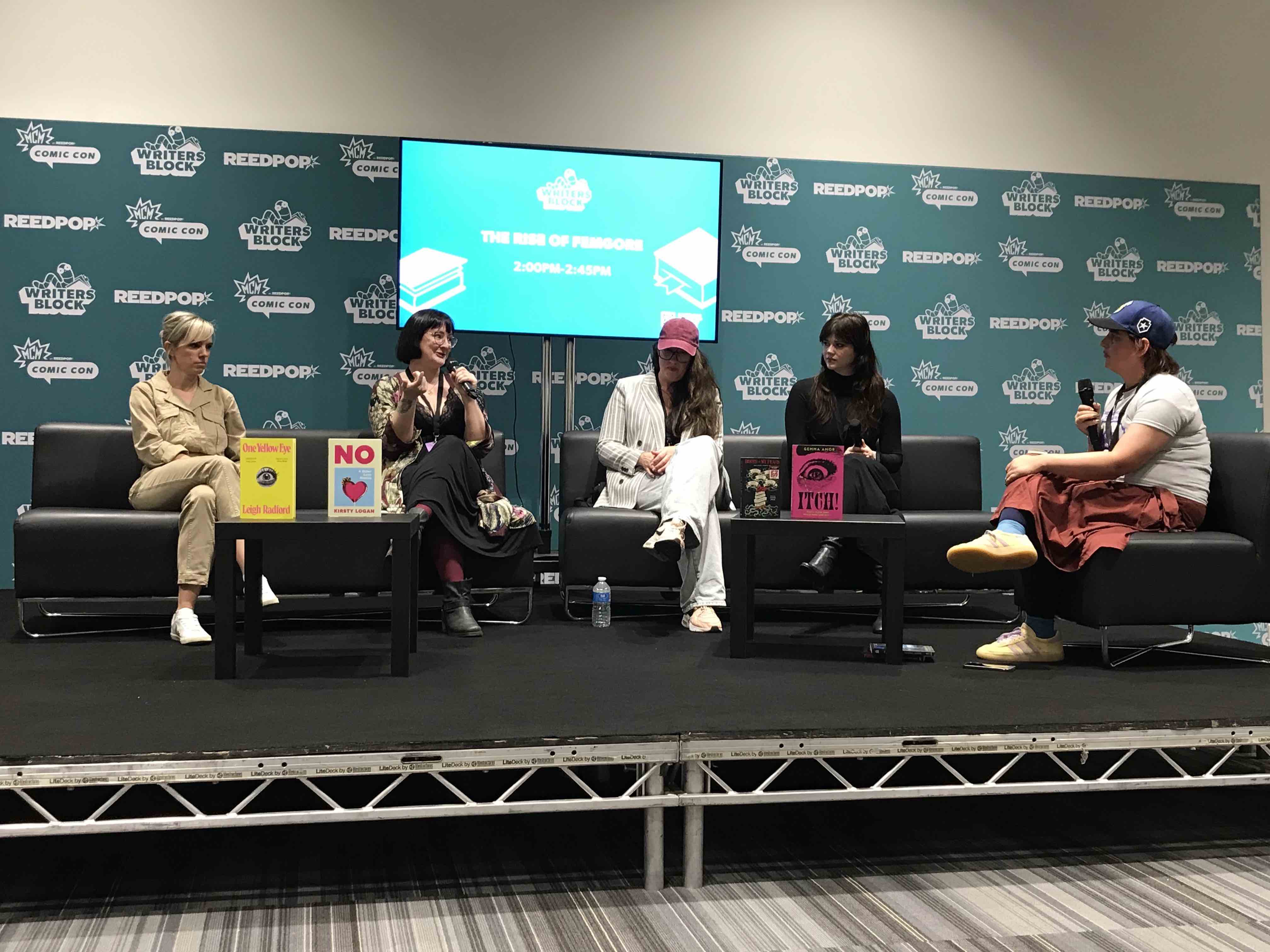
Amor maintained that femgore isn’t about ‘the final girl solution’ stereotype. In a way, it’s about women being openly uncomfortable in their own skin. Femgore as a genre is empowering because writers like Amor can sit on their own writing this genre, but they feel like they are a part of a movement.
“It’s not just about violence committed against us,” Redford said. “Femgore is about articulating shame. Women asked to constantly sanitise and censor themselves physically and emotionally. The genre creates a language that allows us to do that.”
Amor sees the rise in the reader’s acceptance of “women writing women” horror genre. She called it pink horror. She pointed out that male writers writing female characters win book awards but female writers writing male characters don’t necessarily win such awards. She also noticed another pet peeve. “In horror, women pitted against each other like in the movies,” she observed. “I want a slightly different narrative.”
Femgore isn’t about ‘the final girl solution’ stereotype.

Alienation: the cost of writing femgore
“I don’t like that story, women against each other,” Logan agreed. But she discovered that writing femgore comes at a cost. “You feel excluded,” she said. “People think: ‘The genre is for other people, not for me’… I’m not going to be in the Richard and Judy book club.”
“The more gore, the more the readership shrinks,” Redford observed. “Women don’t want to read about their brutal experience. It’s ridiculous. It allows us to explore the limits of human emotions. It gives us the language to do so. It’s nice to see more angry, violent conversation amongst feminist writers.”
“It’s nice to see more angry, violent conversation amongst feminist writers.”
Must beauty fall for the beast?
And then there’s the stereotype in horror of the ethereal beauty falling head over heels with the butt ugly monster. Why not the other way around? If the beautiful Elizabeth in Frankenstein can fall for The Creature, is it impossible for a handsome young man to fall for the hag? That’s a notion many find troubling, no doubt.

The MCM Comic Con London panel Hags, Grandmas & Witches: [Older] Women in Comics at the Artist Alley on 24 October 2025 asked the question: At what point do the female characters in comic books become invisible?
Comic authors Sarah Miles, Chrissy Williams and Lucy Sullivan examined hags and witches in folklore portrayed as ‘bad stepmothers’ and ‘stealers of youth’ – Snow White and Rapunzel being perfect examples.
“We must move along from this maiden, mother and crone parody,” said Williams. “We are stereotyped as ‘caring for other people’. It’s important that we define ourselves not just as carers.” Horror, she said, has a function to enlighten the readers. “Come for the violence, stay for the story about community and menopause.”
Sullivan reflected that she doesn’t serve first at the bar because of her age. Her comic Barking is about a woman whose madness manifests into a mad dog barking at her. “Why are we so angry?” She asked. “Female rage is hardly represented. It’s raging mad and quite angry but it doesn’t show.”
Williams asked: “Where are the women in comics? Spider-Man’s Aunty May is looking hotter in the film. Are we back to erasing older women?”
These views were also echoed by the Femgore panel, in which Logan said that she’d like to see more ‘hag horror’. “Why can’t we have women looking gross? Where is my hag protagonist? Or ‘prohagonist’?”
There’s the stereotype in horror of the ethereal beauty falling head over heels with the butt ugly monster. Why not the other way around?

Paranormal romance
The MCM Comic Con London panel Cloaks, Wands, Pleasure and Pain at the Writer’s Block on 24 October 2025 dug deeper to explore the possibility of paranormal love.
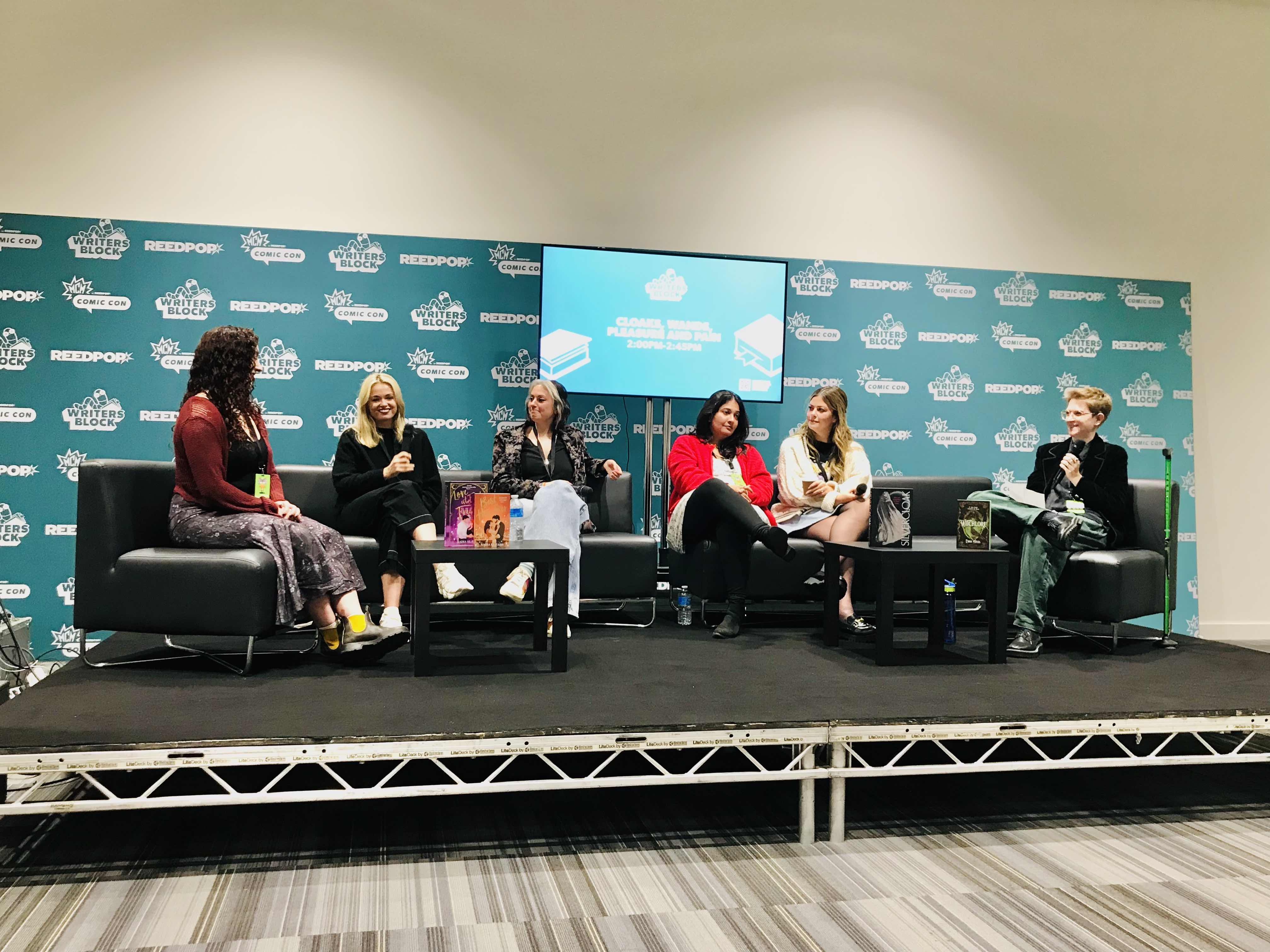
Authors Nadia El-Fassi, LK Stevens, Kate Dylan, Sangu Mandanna, Lucy Jane Wood and Emma Hinds looked at the limits and potential of love outside the male-female binary as they talked about magic, witchcraft and worldbuilding.
Stevens said that in her universe “world magic is priority. Anyone can give pleasure and pain. It makes sense in my magic system. (For example) food gets pleasure, and pleasure gets more magic.”
Dylan proposed something that got us thinking. She highlighted that when we remove religion and procreation aspects in love and relationships, homophobia doesn’t even make sense. In a fantasy genre that refuses to be shackled by the heteronormative world, love like this is not impossible.
Love, the premise of horror
The most memorable horror stories are ones of unrequited love, the yearning for acceptance intense – and unfulfilled. This is the gist of Samuel Taylor Coleridge’s Christabel, Bram Stoker’s Dracula and Anne Rice’s Vampire Chronicles. Frankenstein is no different. It’s about love driven by hurt.
During the Femgore session, Redford told the audience that she wrote based on her personal experience of watching her father dying from leukaemia. She said: “You’re going on instinct, you go into explosive rage, you write about it and then you can process it rationally.“ She concluded: “Grief is the price you pay for love.”
“I wrote my first novel after my father died,” Logan said. “I respect love after experiencing the complications of love.”
“Love is rather awful,” said Amor. “It’s complicated. When juxtaposed against a horrific situation, it gets you into an extreme situation and affects how you behave. It’s the premise of a horror book.”
The most memorable horror stories are ones of unrequited love.
For the love of monsters
‘Formula’ horror books will continue to be published because they sell. Comebacks such as femgore are to be expected to counterbalance the former. But despite the patriarchy of Frankenstein, we owe it to Shelley for writing such as an endearing monster. Life and love were hard for Shelley. Her horror story came at the time when science had begun to privilege rationale and facts over myths and miracles. Her story and the stories of the femgore authors make up for what scientific progress denies us: our need to openly acknowledge and indulge in our fear and sadness.
More on feminist horror on Story Of Books
- Tartan Noir at the London Book Fair 2018 (Story Of Books, April 2018)
- A taste for horror: how to write a good scary story (Story Of Books, 14 June 2019)
MCM Comic Con London October 2025

 Story Of Books